
Why Puppy Classes Often Miss the Point
When most people sign up for puppy training, they picture a tiny dog who quickly learns to sit, stay, walk nicely on leash, and respond perfectly when called.
During my training programs, I do introduce basic obedience skills, but it’s important to set a clear and honest expectation:
Puppy training is not about producing a fully obedient dog.
It’s about building the foundation that makes real obedience possible later. Most dogs who struggle to behave appropriately or even struggle with reactivity, resource guarding, separation anxiety, or insert just about any behavioral issue here, are not struggling with a lack of skills. They’re struggling to self regulate, navigate the world confidently, express their needs, are do a combination of those things.
If you spend a day with my dogs, the first thing that you’ll notice is that they aren’t often being given instructions. I might recall them away from the door for really exciting guests or ask them to heel while we’re running errands, but day to day, they just read the room and play when it’s play time, settle when we’re inside, and follow my lead. This is because when they were young (or when they were new to me), I focused heavily on teaching them to self regulate and made sure their only real options were to behave appropriately, slowly giving more freedom as those routines became habits.
With puppies especially, obedience cues are something we’ll introduce casually early on, but not the priority. A confident, boisterous Marley and Me type can often be turned into a Canine Good Citizen in as little as 3-4 weeks. On the other hand, a dog who is afraid, insecure, or anxious, will take significantly more time to work with. That’s why I focus SO much more heavily on building confidence, intentional socialisation, teaching self regulation skills, and helping owners build relationships with their dogs. “Reigning in” a secure, happy dog is so much easier than building a dog up after we’ve missed critical developmental periods.
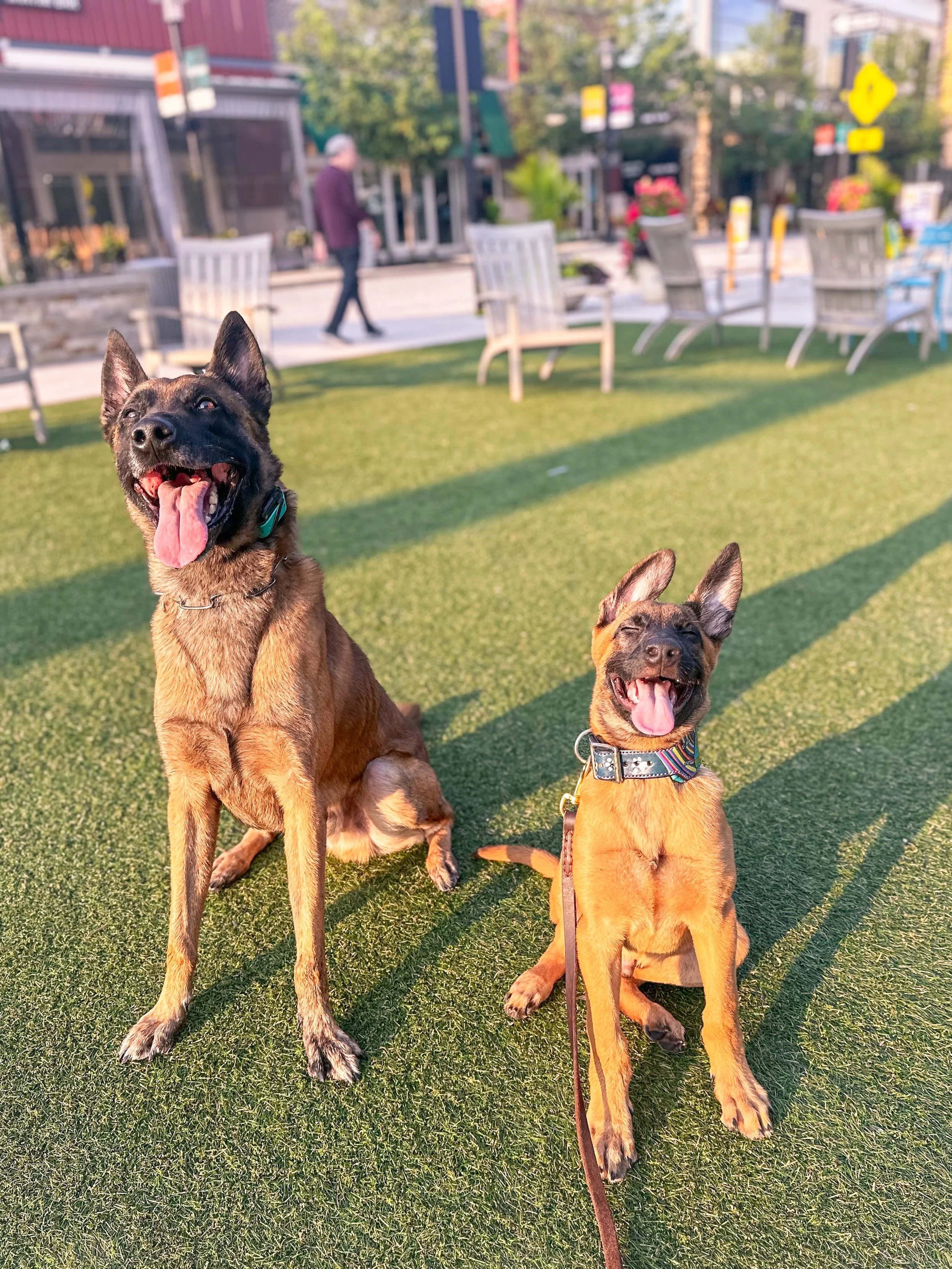
Understanding Puppy Brains
It’s important to remember that while puppies are our soon to be best friends, they are also still developing mammals moving through rapid neurological, hormonal, and emotional changes.
Each stage of development comes with different learning capacities.
When we expect adult-level reliability from a baby brain, frustration builds. I often meet people who want to do everything right from the start and have the perfect puppy- let me be the first to tell you that raising puppies has its ups and downs even for professionals. It took me several puppies to learn that I need expect less than perfection and just enjoy puppyhood before it’s over. It doesn’t last long enough!
When we instead align training with development, progress feels smooth.
Let’s walk through the stages.
🐾 8–12 Weeks: Pattern Formation
This is where most owners begin training.
At this stage, your puppy’s brain is extremely adaptable. They are:
Learning routines quickly*
Forming strong emotional associations
Absorbing environmental information
Developing confidence (or sensitivity)
But they are not neurologically capable of:
Sustained impulse control
Reliable obedience under distraction
Long duration behaviors
Advanced proofing
Their prefrontal cortex, or the part responsible for impulse control and decision-making, is immature. You’ll hear me say puppies have spongey brains, because they absorb so much and have almost nothing to show for it the next day, this is what I mean.
So when your 9-week-old “knows sit” in your kitchen but forgets it outside, your puppy isn’t stubborn or falling behind, they’re just the dog equivalent of a toddler.
This is why our focus early on is:
House training clarity (the most difficult thing to fix if we don’t nail down by six months!)
Structured crate routines
Calm tethering and settling
Engagement habits
Intentional (neutral) socialization
Play structure and impulse foundations
We are building emotional architecture.
*Learning routines for puppies doesn’t mean the type of routine we’re thinking of- “Wake up at seven, breakfast at eight, out the door at nine”, think more routines like “wake up, go outside, go to the bathroom”, or “human picks up shoes, grabs leash, we go for a walk”.
🐾12–16 Weeks: The Socialization Window
This is the most sensitive developmental phase.
Your puppy is highly impressionable. Experiences during this window shape long-term responses to:
People
Dogs
Environments
Sounds
Novel situations
This is where many training mistakes happen.
Over-socialization, chaotic dog parks, poorly structured daycares, or forcing interactions can create long-term reactivity.
Proper exposure during this stage looks like:
Calm observation
Controlled introductions
Environmental neutrality
Confidence-building experiences
Play and engagement with you in new environments
We still build obedience foundations here- things like recall beginnings, leash positioning, basic sit and down, but the real priority is shaping how your puppy feels about the world.
Because a confident nervous system is more important than a flashy sit.
🐾4–6 Months: Testing and Transition
Around this age, you may notice:
“They know it, why are they ignoring me?”
Neurologically, this stage brings:
Increased independence
Early hormonal influence
Slightly improved impulse control
Beginning boundary testing
Essentially, your puppy now has thoughts and opinions. Great timing, because they’re also teething. Isn’t that such a fun coincidence?
Now we can start:
Increasing criteria
Adding mild duration
Expanding distractions
Tightening structure
But reliability is still limited.
Your puppy is still developing executive function. They are capable of more, but not yet of full adult-level consistency.
Consistency from you during this phase matters more than intensity. This is when most people want to start giving their puppies more freedom because they’re older, not realising that they’ve just shifted from the house training stage to the mischievous pre-teen stage. Keep the options limited for now, you’re almost through it!
🐾 6–9 Months: Where Reliability Begins
This is the major shift.
Hormones rise. Energy increases. Risk-taking behavior shows up.
But something else happens too:
Impulse control improves.
The brain matures enough to begin meaningful proofing. This is when:
We can raise expectations
We can increase duration
We can add real-world distractions
Obedience starts to look polished
This is why I often describe training in two phases:
Phase One builds stability.
Phase Two builds reliability.
If we rush to Phase Two without doing Phase One, adolescence feels chaotic.
If we build properly early on, adolescence becomes structured growth instead of crisis management. You do have a teenager now, but if we play our cards right they can be an honor roll teenager instead of a high school drop out. I can say that because I’m a high school drop out.
What Puppy Training Is Really About
In our puppy foundation program, about 20% of what we do is early obedience skills. Introducing recall, or our “come” cue, teaching sit, down, and the very loose concept of stay, introducing the heel position, etc. A whole lot of introducing and just scattering those skills into your day to day routine with bits of your dog’s meals or through play.
The other 80% is what actually determines whether your dog becomes stable and enjoyable to live with:
House training clarity
Structured routines
Settling in the home
Engagement under mild distraction
Proper socialization
Impulse control
Frustration tolerance
Environmental confidence
As someone who focuses largely on behavior modification and serious issues, I’ve never met a problem dog who became what they were because they’re older didn’t know sit or heel.
Their issues developed because:
They never learned how to settle.
They were overstimulated instead of properly exposed.
They never developed impulse control.
They practiced chaos instead of structure.
A good puppy training program focuses on shaping the nervous system that will support those behaviors later.
Foundation Before Flash
It’s completely normal to want visible obedience results quickly.
And you will see progress through improved engagement, fewer accidents, better settling, stronger recall foundations, and more.
Meaningful puppy training is less about producing a robot and more about installing the operating system that makes future obedience reliable.
Think of it like pouring the foundation of a house.
You don’t see walls yet. You don’t see windows.
But without that concrete, the structure cracks later.
Puppy training is the concrete.
Adolescent training is the framing.
Adult training is the finish work.
A Final Note
It’s completely normal to want visible results quickly, and you will see progress.
Meaningful puppy training is less about producing a robot and more about shaping a stable nervous system.
We’re not just teaching behaviors.
We’re shaping the kind of dog your puppy grows into.
That work starts now and requires casual, day to day consistency throughout adolescence.
Resources
I offer in home puppy lesson programs within about 20-30 minutes of King of Prussia. Everyone has a different learning style and different needs, so if you prefer to start with a group class (cost effective and a great start for confident, secure puppies!) or daycare type learning environment, these are trainers that I recommend below. Keep in mind that the dog training industry is entirely unregulated- anyone can call themselves a dog trainer without results or education to show for it. If you’re unsure what might be best for your puppy, feel free to contact me to set up a call. If we’re not a good fit, I am always happy to have a phone call and refer you only to trainers that I would trust with my own dogs at no charge.
Furst Steps- Enrichment daycare and structured puppy training daycare, Hatboro
I have worked with multiple dogs who got their start with Alex at Furst Steps, her alumni have given glowing reviews regarding standard of care and her quality of training and puppy foundation is obvious when interacting with them. While I often recommend against traditional doggy daycare, this is an amazing option for busy families who want to raise adaptable, well rounded puppies.
Furry Elite- Enrichment daycare and group classes, Audobon
Tri-Dog Solutions- Enrichment daycare, day training, pack walks, private lessons, Oaks/Phoenixville
Old York Dog Training Club- Low cost group classes, Horsham
